UBL
Summary #
- tags
Universal Business Language (UBL) is an open library of standard electronic XML business documents for procurement and transportation such as purchase orders, invoices, transport logistics and waybills.
UBL was developed by an OASIS Technical Committee with participation from a variety of industry data standards organizations.
UBL is designed to plug directly into existing business, legal, auditing, and records management practices.[1]
It is designed to eliminate the re-keying of data in existing fax- and paper-based business correspondence and provide an entry point into electronic commerce for small and medium-sized businesses.
oasis-open.org creators of UBL #
Objectives #
UBL can be thought of as a lingua-franca — a (data format) language
that allows disparate business applications and trading communities to exchange information along their supply chains using a common format.UBL also provides the opportunity to end the debate over standards for business document formats that has discouraged the adoption of new technologies for conducting business in the digital age.
Possibly the largest impact of a standardized royalty-free data format over the long run will be its creation of an entire computing ecosystem, like the ecosystem that was created by the universal adoption of HTML and HTTP two decades ago. UBL is rapidly becoming established as the equivalent of HTML for business documents in the digital age.
Functionality #
UBL is designed to plug directly into existing business, accounting, legal, auditing, and records management practices, eliminating the re-keying of data required by traditional fax, scanned-image and paper-based supply chains and in doing so provides an entry point into electronic business for small and medium-sized businesses.
Although designed for use in business supply chains it can be (and has been) adapted for other contexts of use. This is because all the business document constructs in a UBL are drawn from a single library of reusable components. This ensures a high degree of alignment among the various parts of the UBL specification, and the assembly of XML schemas from a common element base facilitates code reuse in processing applications.
The library-based design of UBL has a couple of profound practical implications.
First, it means that common data structures such as Address and Line Item are implemented with exactly the same XML structures in every document type that uses them. The implications of this for program code reuse (and by extension, the cost of processing software) are obvious. Less obvious, but equally important, is the fact that complex documents such as Order that are received early in a transactional sequence can easily be “flipped” to generate corresponding documents such as Invoice later in the sequence, since many of the original document structures can be reused in the subsequent ones.
Another critically important aspect of UBL design is its support for customization to meet the needs of individual organizations while maintaining complete interoperability within the standard framework. To suit the requirements of specific trading relationships, data structures of arbitrary complexity can be added (by mutual agreement) to UBL documents without breaking XML validation against the standard schemas.
Learning #
Youtube #
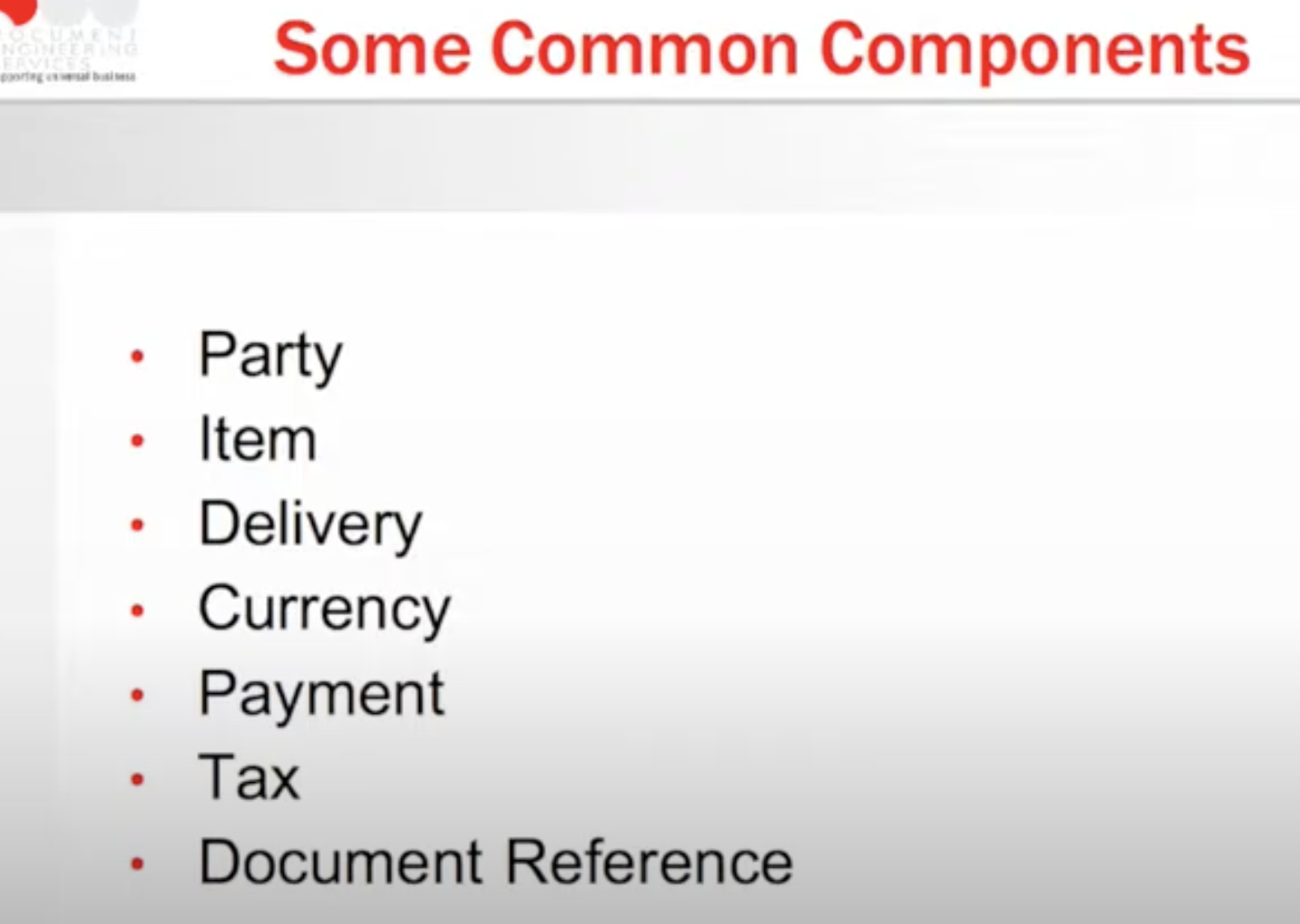
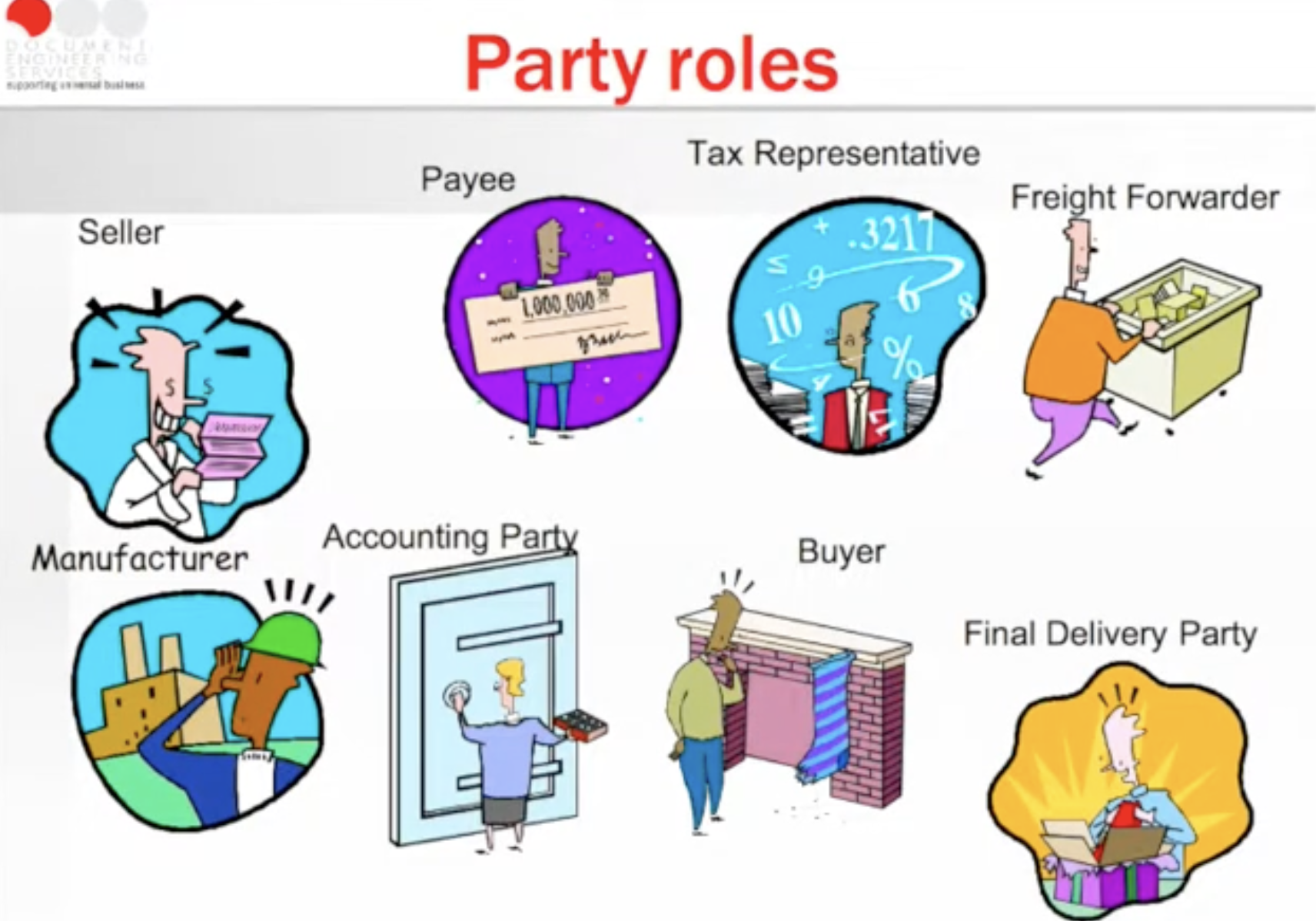
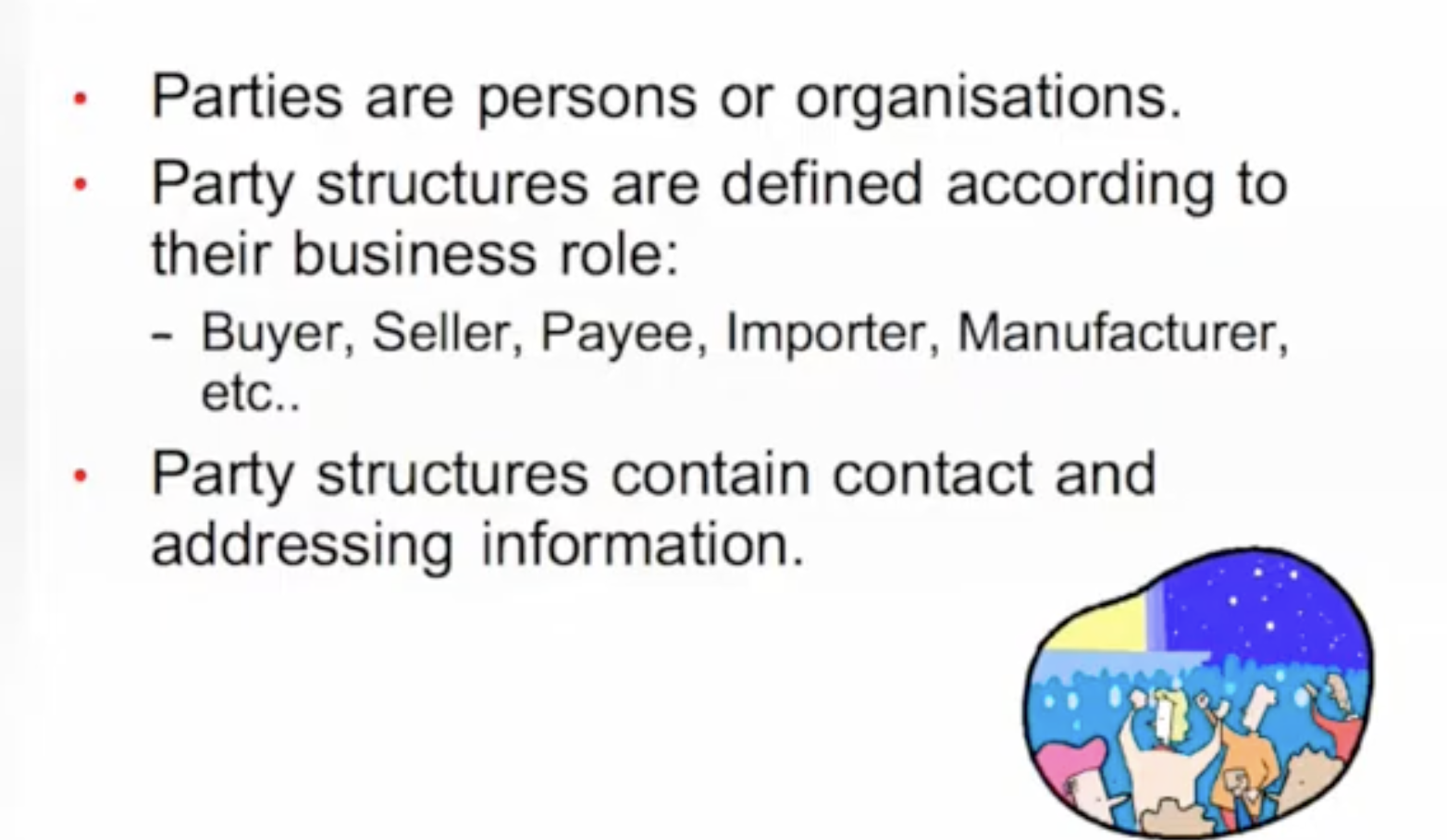
Party #
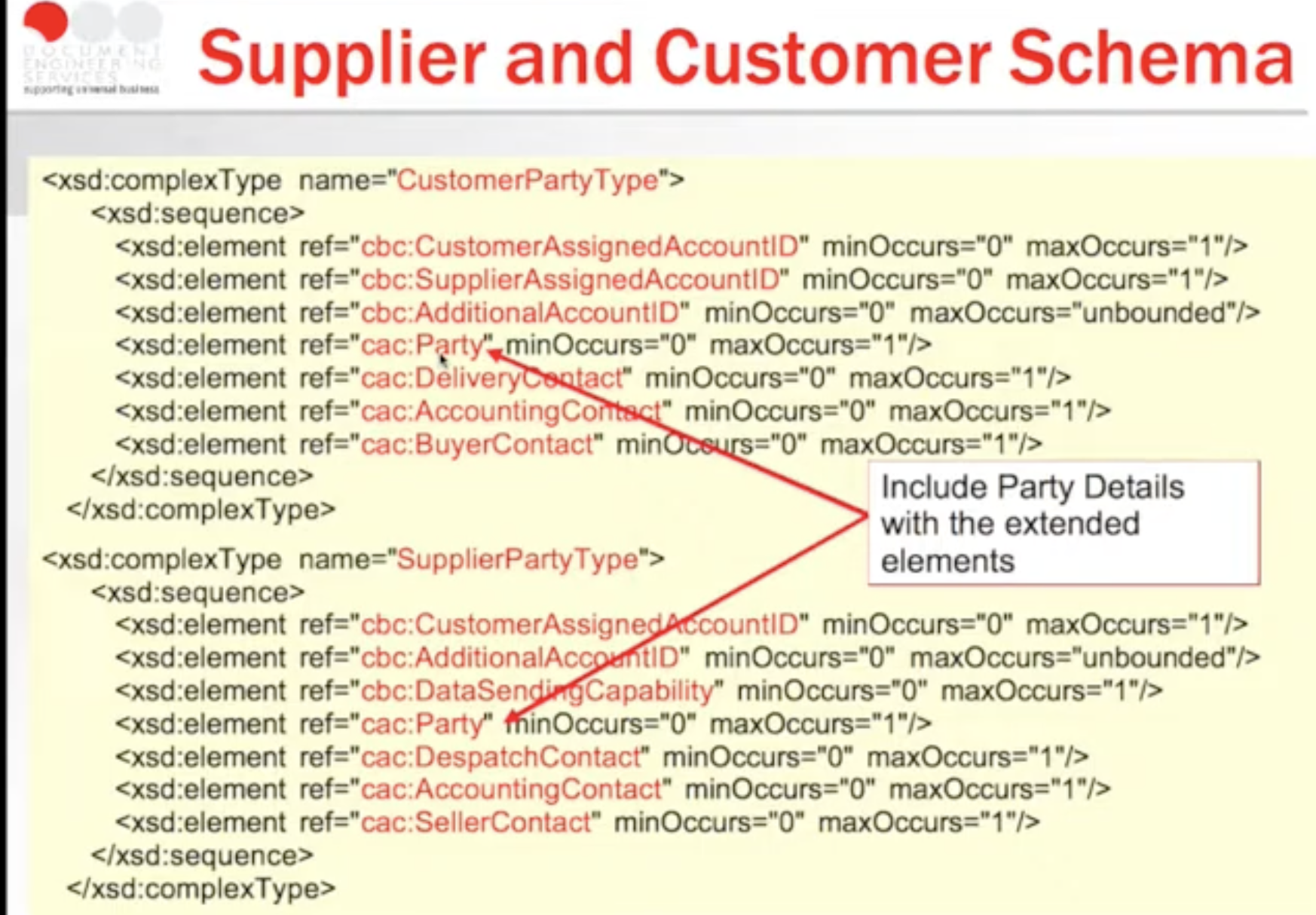
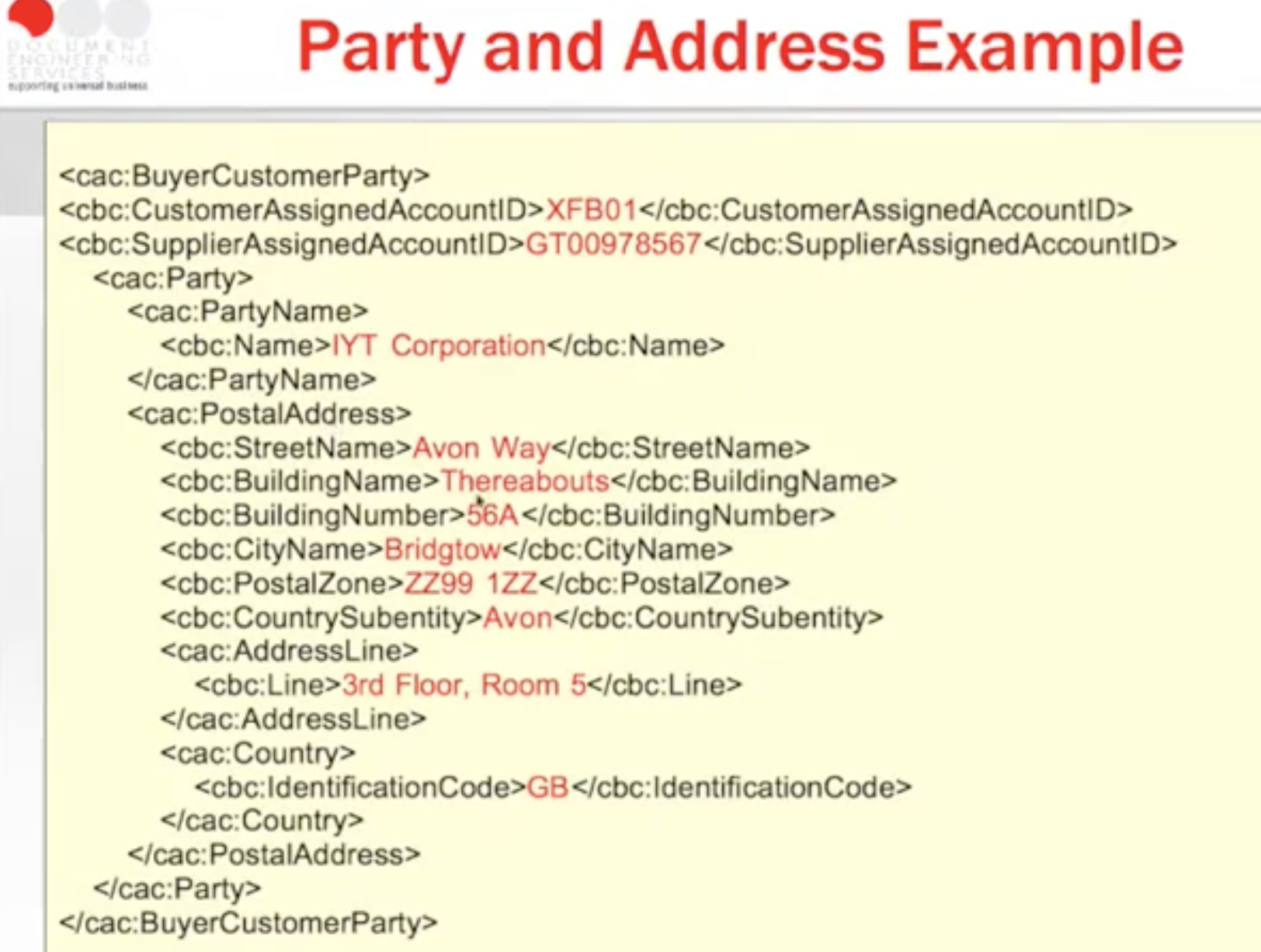
 UBL schema of party
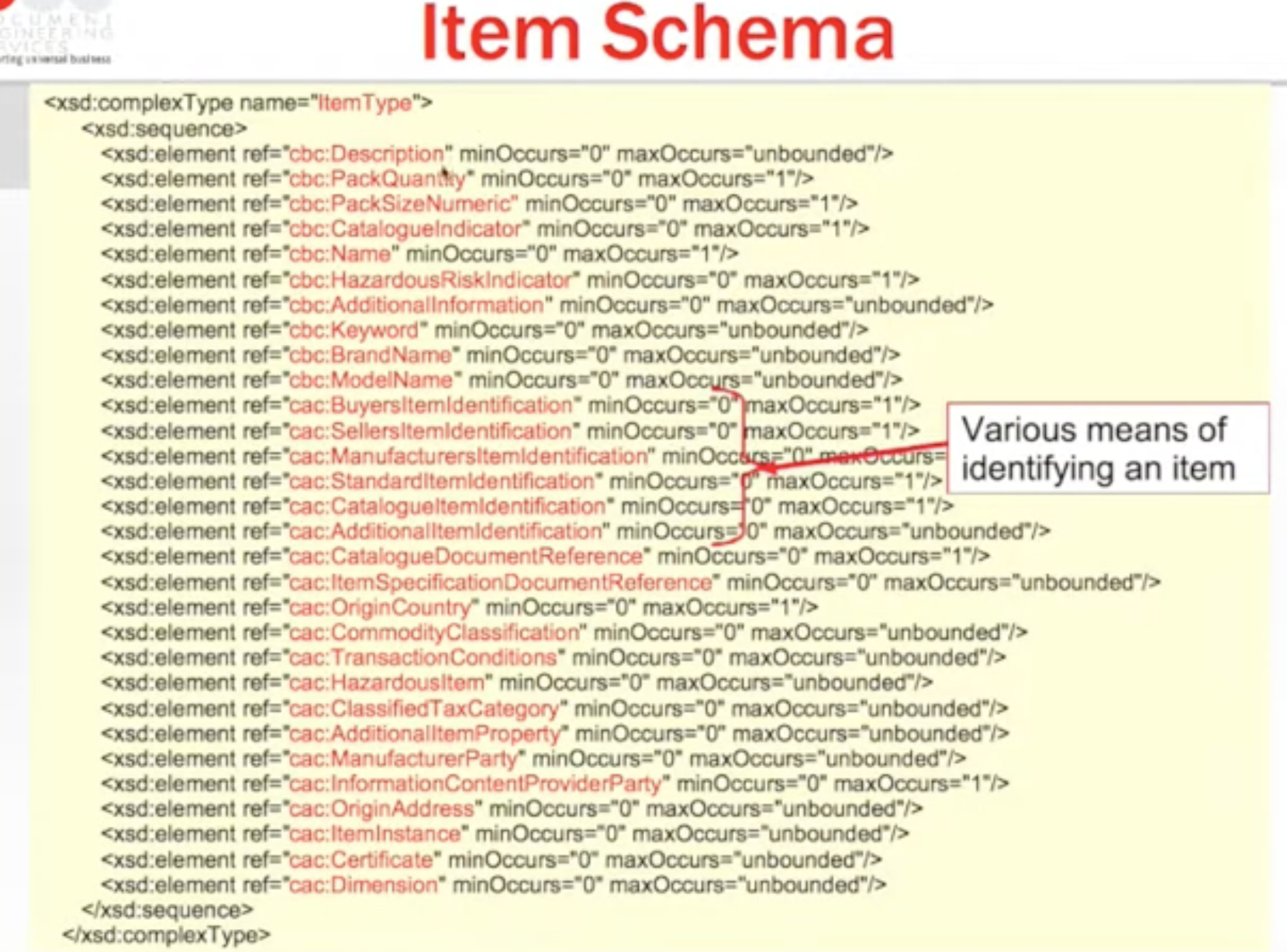
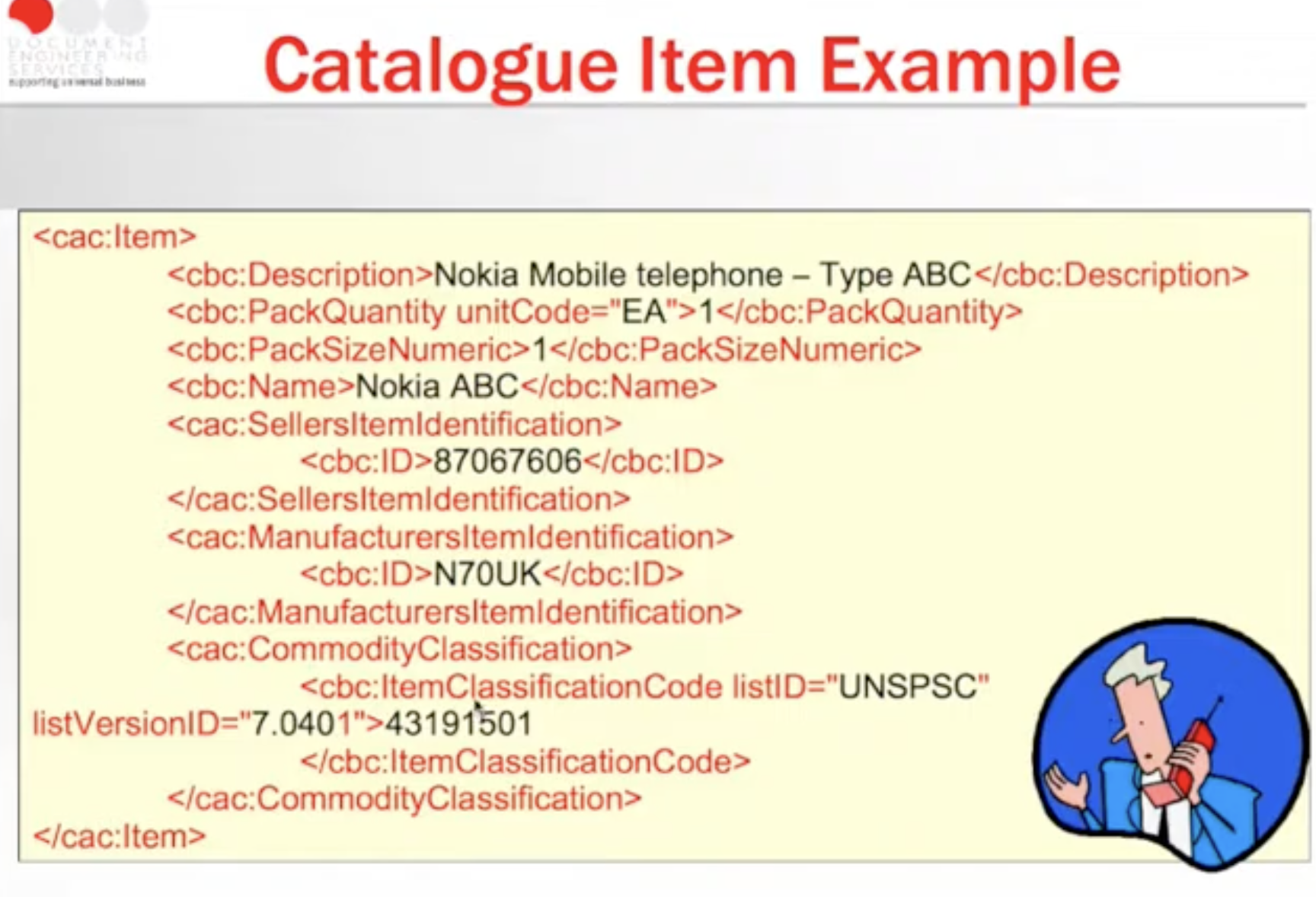
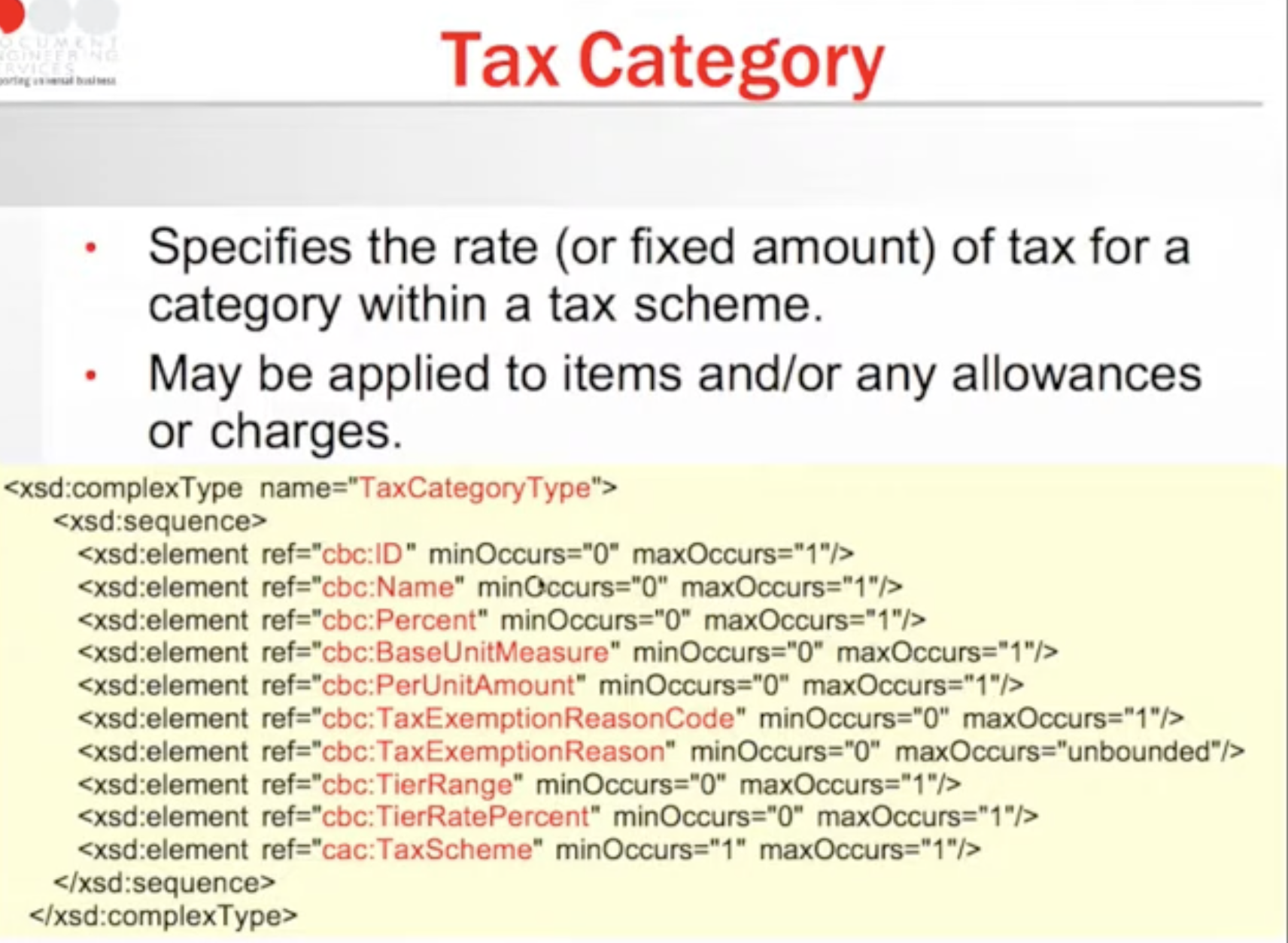
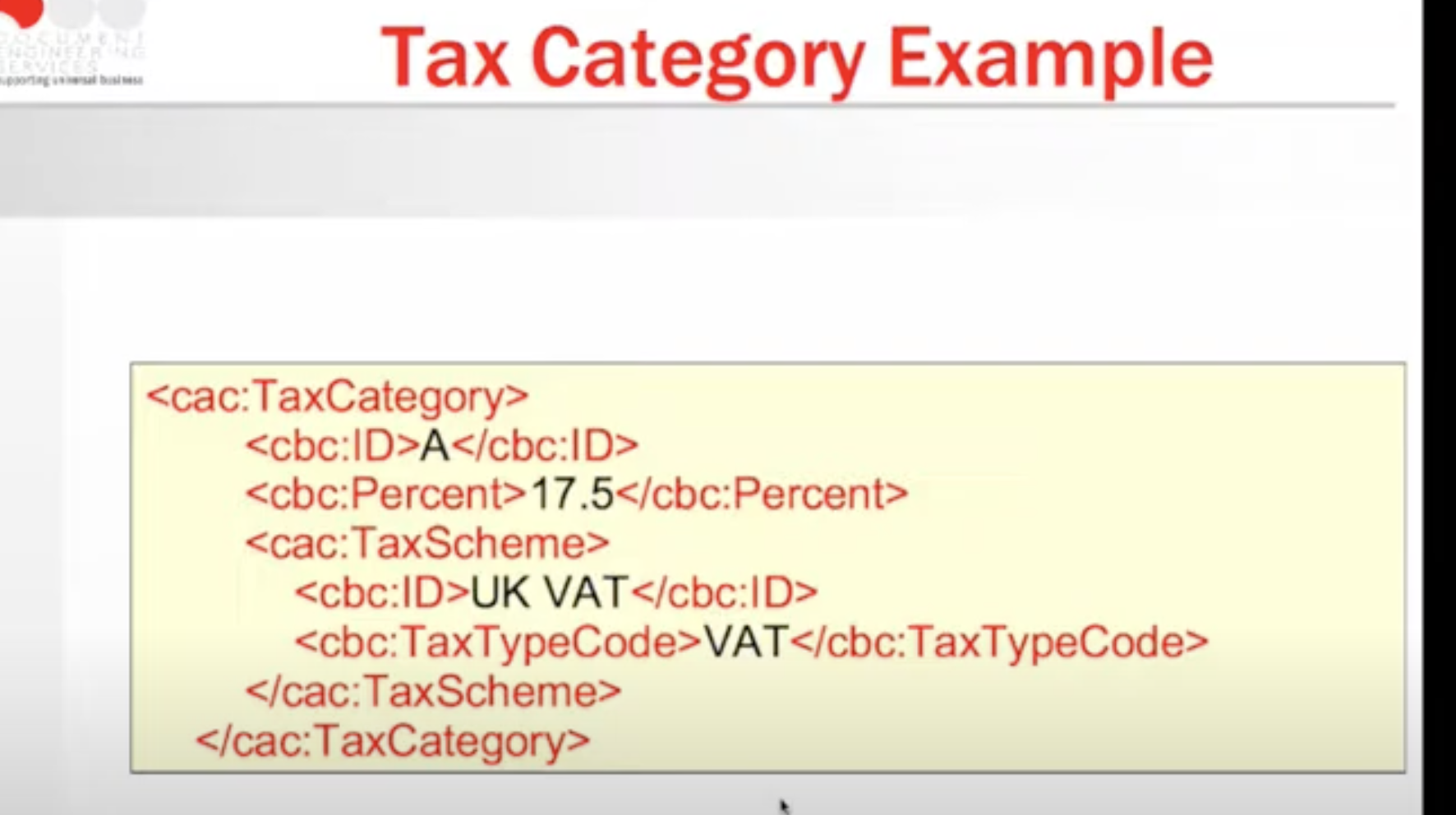
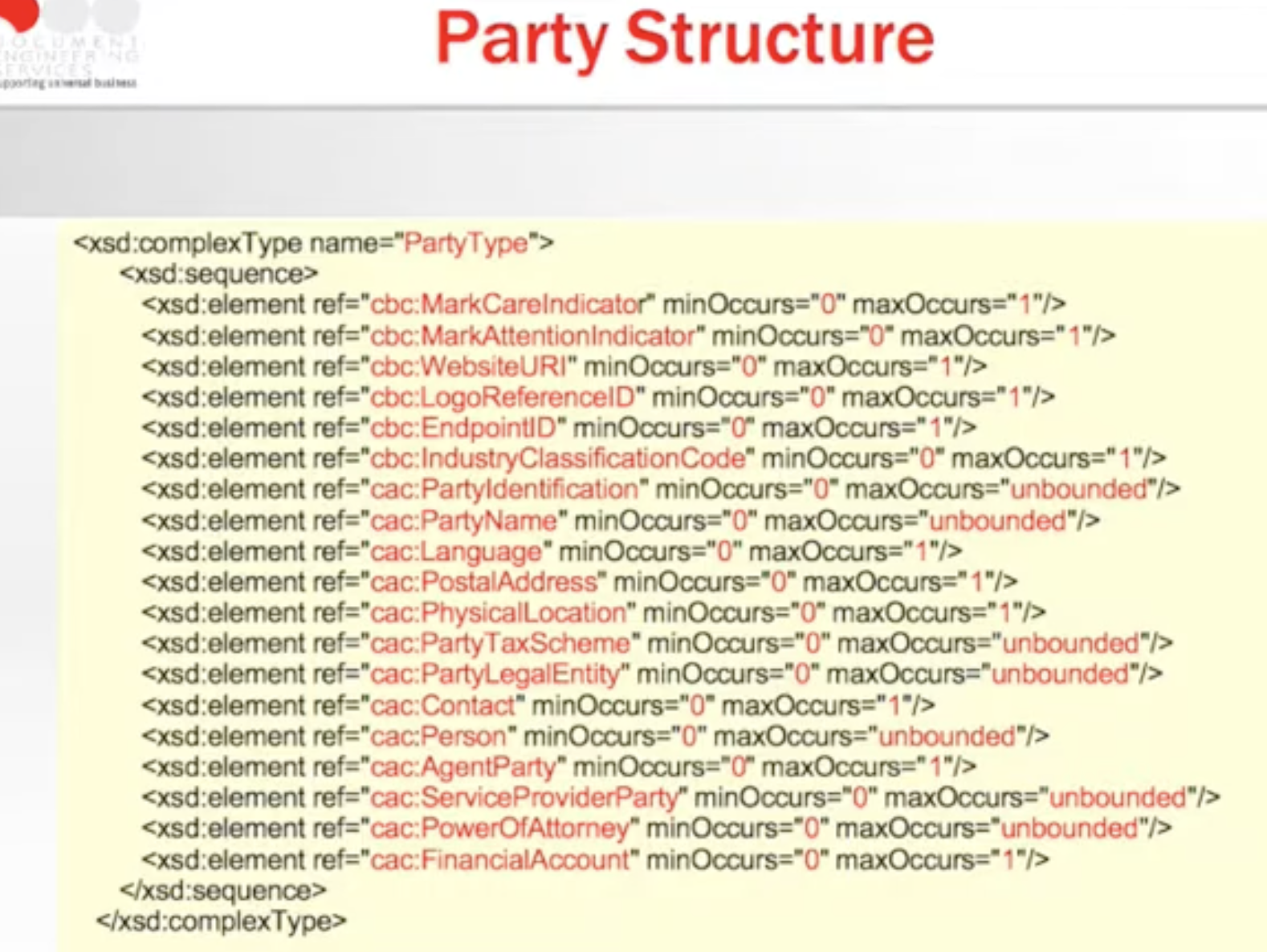 cbc: common basic component (leaves)
cba: common aggregate component (can be broken down)
cbc: common basic component (leaves)
cba: common aggregate component (can be broken down)