Technologies Used in Fintech
#
tags :
#
#
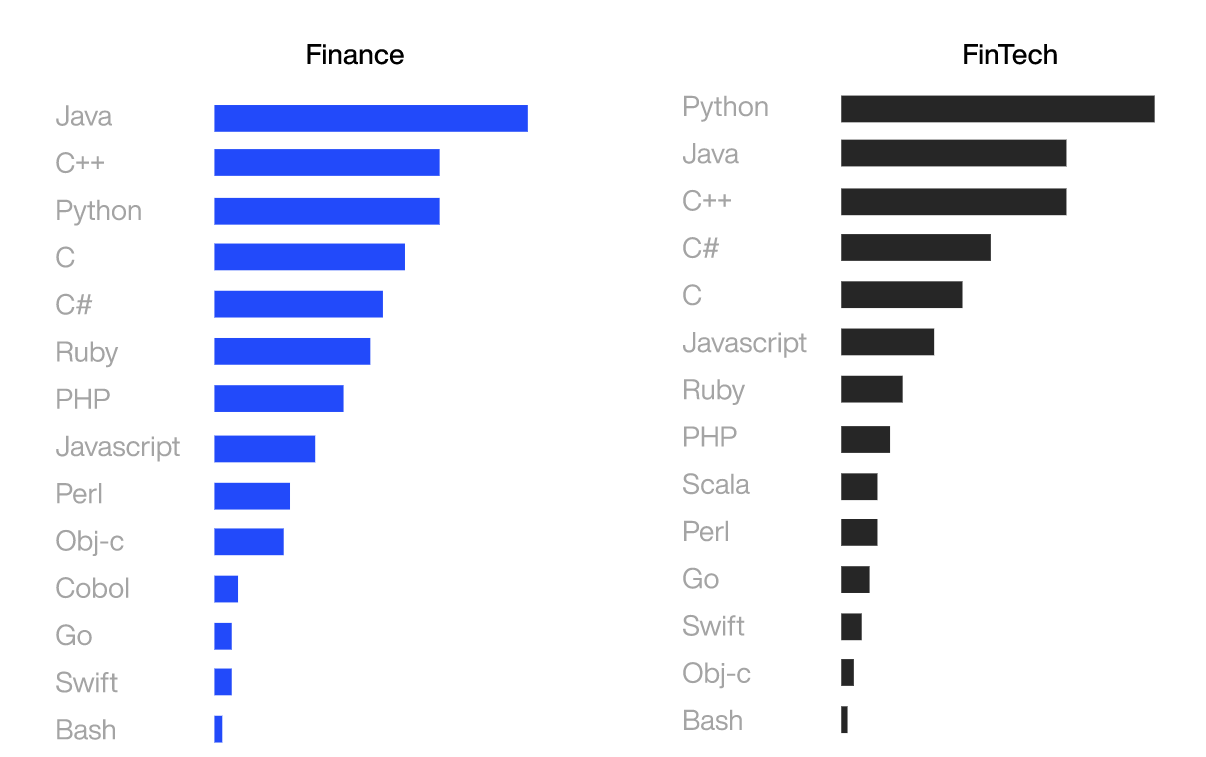
- Most popular language in this space
- Python has undoubtedly taken the world of finance by storm.
- The high-level nature of the language makes it more appealing to researchers and quants alike, and that has contributed to its popularity.
Why? #
- Clean, readable, elegant easier to adopt across the board
- Reliable choice for security
- Robust framework like
- Goto language for , and data science projects Makes it easier for Fintech to use bleeding edge techs
- good for quantitative finance
- Huge tools and libraries for maths and statistics
Examples #
- Marqeta
- N26
- Nubank
- Revolt
- robinhood
#
- 2nd most popular
- Financial services companies use Java extensively.
- Several of the world’s largest banks use it as their retail banking sites, electronic trading platforms, wealth management platforms, and other front-end applications that interact with their customers.
Why? #
- Already popular in Banking and ERP space
#
This language is a popular choice for Fintech companies that work with data architecture and cloud-based platforms, so learning Scala can be helpful if you want to develop mobile applications.
Why? #
Uses
#
- Compared to most of the other languages on the list, C++ is closer to the machine.
- Thus, it is an excellent choice for high-frequency trading systems because it is much faster.
- The company pays tens of thousands of dollars to place its servers right inside the stock exchanges because high-frequency trading requires such low latency!
Why? #
When speed is the factor
#
Frameworks #
- references botreetec
#
Powered by Python, Django is a primary framework for FinTech app development services. The framework offers an amazing interface and capabilities to develop complex FinTech solutions. Robinhood, one of the biggest commission-free stock trading apps, uses Django in its technology stack. Django offers packages like the Django REST API, Sentry, and more to simplify the process of application development. The framework also offers capabilities for numerical computation, analysis, and scientific computing to integrate AI and ML in FinTech applications.
Examples #
#
Also known as “the startup technology,” Ruby on Rails is the choice of framework for quick MVP development. The framework, along with the assistance of the best software development company, reduces the development time by 25% to 40%. With the ever-increasing competition in FinTech, companies need a technology that can offer them the best of speed, flexibility, and scalability. Ruby on Rails has all these three advantages. It powers apps like Coinbase and Chime.
#
Java Framework #
The Java-based framework offers amazing features to create FinTech applications. It simplifies complex project requirements by offering ready-to-use components. Spring provides a robust mechanism for authentication and authorization – a key necessity for FinTech products. Spring projects evolve actively as they revolve around the Java ecosystem. The framework offers scalable app development, ensuring FinTech companies stay on top of their game. Spring receives regular updates, making it a trending framework for FinTech development.
#
#
#
Databases #
- references bototree