RISC vs CISC
- tags
- ,
CISC vs RISC #
CISC #
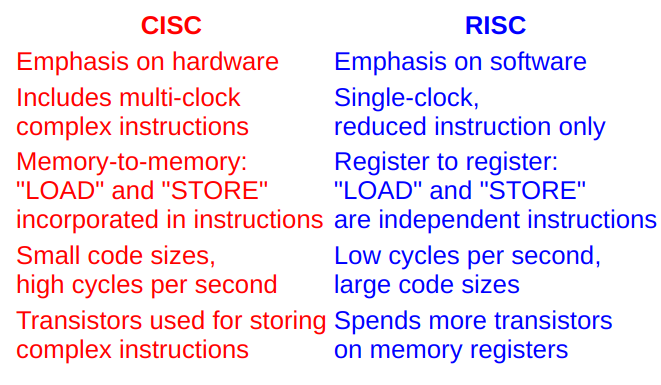
The primary goal of CISC architecture is to complete a task in as few lines of assembly as possible. This is achieved by building processor hardware that is capable of understanding and executing a series of operations. For this particular task, a CISC processor would come prepared with a specific instruction (we’ll call it “MULT”). When executed, this instruction loads the two values into separate registers, multiplies the operands in the execution unit, and then stores the product in the appropriate register. Thus, the entire task of multiplying two numbers can be completed with one instruction:
MULT 2:3, 5:2
The primary goal of CISC architecture is to complete a task in as few lines of assembly as possible. This is achieved by building processor hardware that is capable of understanding and executing a series of operations. For this particular task, a CISC processor would come prepared with a specific instruction (we’ll call it “MULT”). When executed, this instruction loads the two values into separate registers, multiplies the operands in the execution unit, and then stores the product in the appropriate register. Thus, the entire task of multiplying two numbers can be completed with one instruction:
RISC #
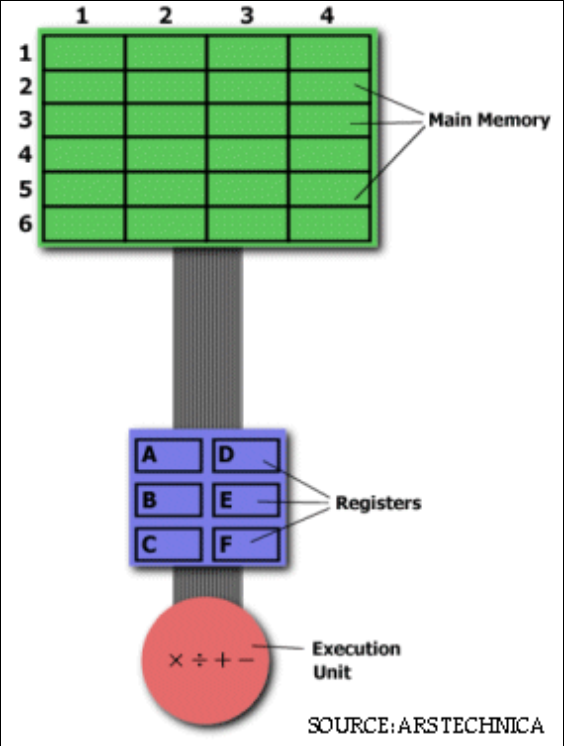
RISC processors only use simple instructions that can be executed within one clock cycle. Thus, the “MULT” command described above could be divided into three separate commands: “LOAD,” which moves data from the memory bank to a register, “PROD,” which finds the product of two operands located within the registers, and “STORE,” which moves data from a register to the memory banks. In order to perform the exact series of steps described in the CISC approach, a programmer would need to code four lines of assembly:
LOAD A, 2:3 LOAD B, 5:2 PROD A, B STORE 2:3, A
At first, this may seem like a much less efficient way of completing the operation. Because there are more lines of code, more RAM is needed to store the assembly level instructions. The compiler must also perform more work to convert a high-level language statement into code of this form.
However, the RISC strategy also brings some very important advantages. Because each instruction requires only one clock cycle to execute, the entire program will execute in approximately the same amount of time as the multi-cycle “MULT” command. These RISC “reduced instructions” require less transistors of hardware space than the complex instructions, leaving more room for general purpose registers. Because all of the instructions execute in a uniform amount of time (i.e. one clock), pipelining is possible.
Separating the “LOAD” and “STORE” instructions actually reduces the amount of work that the computer must perform. After a CISC-style “MULT” command is executed, the processor automatically erases the registers. If one of the operands needs to be used for another computation, the processor must re-load the data from the memory bank into a register. In RISC, the operand will remain in the register until another value is loaded in its place.