Loyalty Program
Summary #
- tags
- Saudi Arabia
The simplest loyalty program definition is turning customers into brand loyalists requires a repeatable process that incentivizes them to keep buying from you.
- Customers into repeatable customers to drive more sales.
Loyalty membership is essentially the process of rewarding customers through structured marketing strategies for their frequent or continued engagement with your brand.
The more they spend, the more rewards they receive. If you put customer preferences at the heart of your marketing efforts and execute a program well, customers feel good about purchasing from you and that will give your business a competitive edge against your competitors.
Types of programs #
Tiered Loyalty Program #
Separate benefits in different levels Example: Alfursan
Strengths: #
- Focuses on higher-value customers
- Can offer better experiences across tiers than traditional points programs
- More opportunity for customization (and differentiation)
- Encourages additional purchases as members want to achieve more exclusive status
- Gives the best rewards to your best customers
- Doesn’t give away margin to every member
- Higher tier members are less likely to cancel membership
Challenges: #
- Not as attractive for lower-tier customers that won’t spend as much
- Member relationships can be jeopardized if they are downgraded
- More complex, requiring more communication to members on their status – These programs can become confusing which leads to less engagement
- Starting at the bottom tier may seem daunting and be a bigger barrier to entry than free points programs
Subscription-based Loyalty Program #
A subscription-based loyalty program requires customers to pay an upfront, monthly or yearly fee to join. Subscriptions can benefit organizations looking to retain customers for specified amounts of time.
Example: Amazon Prime
Strengths: #
- Attracts your best customers
- Highly engaged customers see the value and engage more
- Benefits are easy to understand
- Member fees can be used to offset the cost of the program or as an auxiliary revenue stream
- Robust data collection on high-value customers
- Offer the most attractive rewards possible
Challenges: #
- High barrier to entry for lower-tier customers
- Potential for a higher volume of customer questions and operational issues
- Takes a highly specialized skillset to build and manage effectively
Value-based Loyalty Program #
an organization pledges to donate a portion of its proceeds to one or more charities, enabling customers to choose the charity that best aligns with their personal values.
Points-based Loyalty Program #
Most popular in retail and restaurants
Strengths #
- Free to join equals low barrier to entry for customer acquisition
- Excellent at collecting valuable zero- and first-party data
- The perfect entry point into your larger loyalty ecosystem – a great way to use engagement tactics to turn occasional customers into more frequent ones
Challenges #
- More difficult to use for brand differentiation because rewards need to be funded
- May not provide the instant gratification that modern consumers want (i.e., need to collect points over time for rewards later)
- May not provide enough value to dramatically increase customer engagement
Cash back Loyalty Program #
Spend a certain amount to get a certain amount back usually in coupons or “cash” that can be used exclusively at a retailer. They’re very easy to understand and maintain. Since the concept is basically the same as points programs, there’s not much more to explain.
Strengths #
- Similar to points programs
- Easy to sign up for
- Redemption of store exclusive rewards can drive additional sales when redeeming “cash”
Challenges #
- Rewards both profitable and unprofitable customers alike
- Doesn’t provide instant gratification
- Not as compelling to infrequent shoppers
- Not much differentiation from competitors’ programs
Coalition Loyalty Program #
Coalition programs are interesting in that they are operated by more than one business. Example: Shukran
Strengths #
- Customers can earn rewards more quickly and have more choice on where to use them
- Each brand gets access to an expanded customer base
- Many of the operational costs to run the program including marketing and the rewards funding are shared with other partners
- The rewards redemption liability is managed by the coalition itself rather than the individual brands
Challenges #
- The data collected is usually owned by the coalition and siloed away from the individual retailers
- No ability for individual retailers to differentiate their loyalty program
- Coalition programs do not give you a competitive advantage or differentiate your company in the marketplace
- Risk of customers earning points with your brand and redeeming them with a competitor
All-In-One Loyalty Program #
Some programs provide elements from several different loyalty strategies. For example, tiered programs with points combined with transactional and experiential benefits.
How to redeem points? #
Buy Vouchers with points #
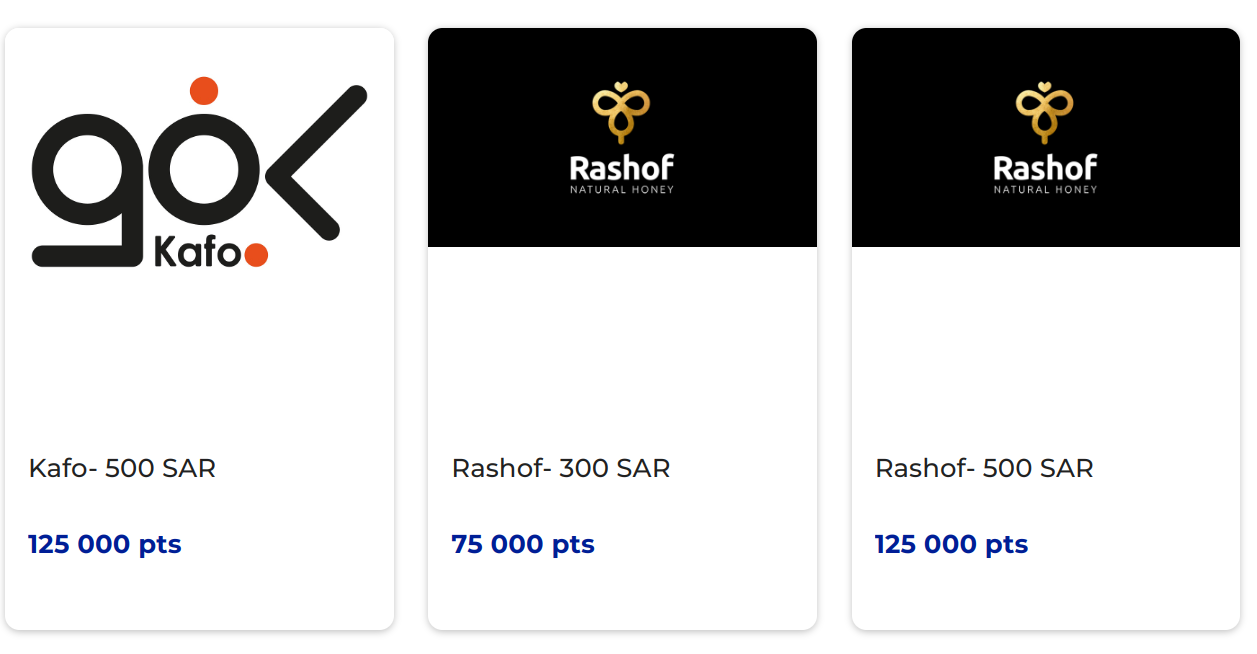
Redeem locally #
Redeem at partners of program #
https://loyalty.alrajhibank.com.sa/en/pages/instore-partners
Exchange points with other programs #
Why Are Loyalty Programs Important? #
Loyalty programs came into existence when companies realized that the competitive advantage that they once experienced due to product differentiation no longer holds good due to a proliferation of similar looking and “me too” products.
In such an environment, having loyal customers became more important and more difficult. So much so that Frederick Reichheld from Bain & Company went on to say that customer loyalty is a rare commodity.
But it’s important to examine the pros and cons of e-commerce loyalty platforms in order to ensure that you choose what’s right for your company and audience. Let’s take a look.
Benefits of Loyalty Programs for company #
- Customer Retention
Online rewards programs increase overall revenue by 5-10%.- Loyalty members spend 5-20% than non-members on average, which not only covers loyalty costs but brings home surplus profits.
- Loyalty program members buy 5-20% more frequently than non-members.
- increasing customer retention by just 5% boosts profits by 25 to 95%
Advantage of customer retention #
- Retention is more cost-effective than acquisition
- Repeat customers deliver better returns.
- Research states that loyal customers buy 90% more frequently, spend 60% more per transaction, and deliver 23 % more revenue and profitability than first-time purchasers. Therefore, retention is a great way to grow and increase profits.
Relevant Customer Data and Consumer Trends #
Use registered customer data #
- behavior
- habits
Consumer data gets recorded in the company’s database as soon as a shopper registers for a loyalty program. Companies can use this data for omnichannel, offline, and e-commerce segmentation, profiling their best customers and tailoring their offerings to specific groups of consumers.
Higher Cart Value #
a company can use collected data to cross-sell and up-sell. increase sales in slow season.
Reducing Unprofitable Customers #
A well-designed loyalty program allows companies to segment customers and discover profitable and unprofitable customers.
More reward to valuable customers #
Through a loyalty program, companies can reward better customers only and thereby minimize the payout to not-so-profitable customers
Better Customer Communication #
Cons of Loyalty Programs #
- Difficult to Gauge Loyalty Behavior
- Balancing the Bottom Line
- Market Saturation
- Inconsistent Profitability
- Limitations of Loyalty Data
Data Model #
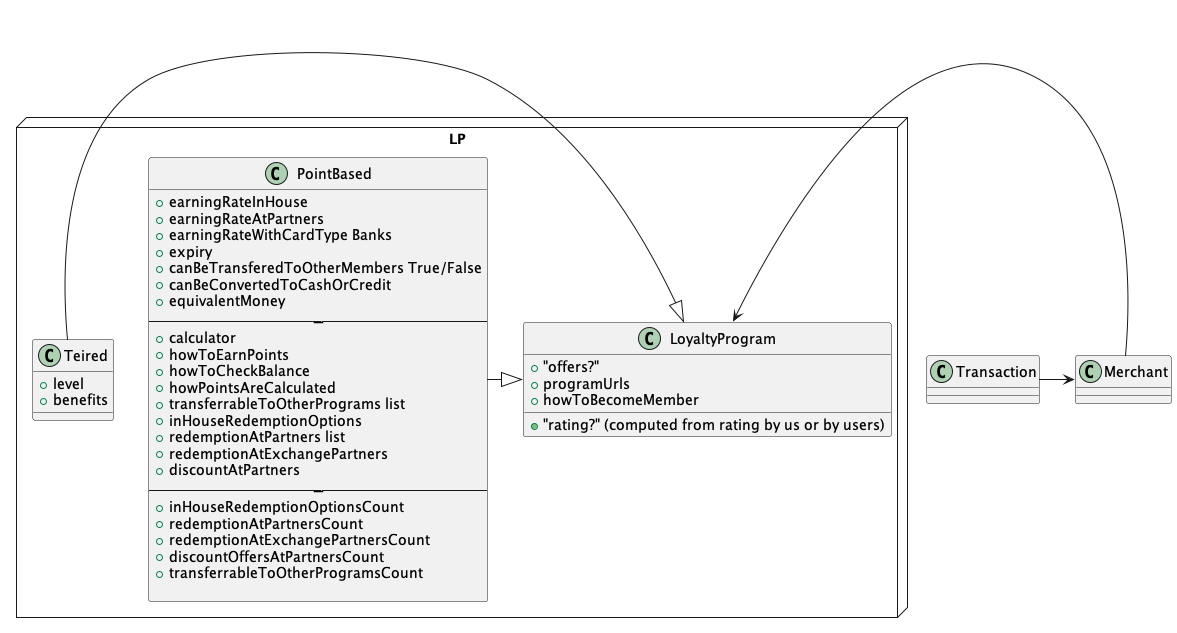
Comparing between loyalty points #
Comparing Point based #
Nahdi vs AlDawaa #
Related #
PointCheckout #
Loyalty Program with Open Banking #
Open banking is changing the face of loyalty programs
Every time an end client earns a cash reward, the bank gets a percentage, much like the revenue generated from interchange rates; however, in this instance, paid with marketing budgets instead of by bank clients. Banks have always sat on the invaluable purchase data their clients generate but haven’t extracted value from it. With a rewards program that retrieves the informed consent of their users, banks can finally put this data to use and leverage an opportunity to create a new stream of revenue.
Using marketing budget to get loyalty program working.
https://openbankingusecases.com/apps/bink
- Adding points automatically with cards
https://openbankingusecases.com/apps/tryflux
- Invoice parsing, parse rich data and share with merchants in exchange of points or offers
https://openbankingusecases.com/apps/goloyal-eu
- Share the transactions and get points
https://openbankingusecases.com/apps/paylead-fr
- Personalized offers or loyalty points when customer shares payment data
Key words #
Performance Marketing #
Payment Marketing #
Account linked offers (ALO) #
Next logical purchase #
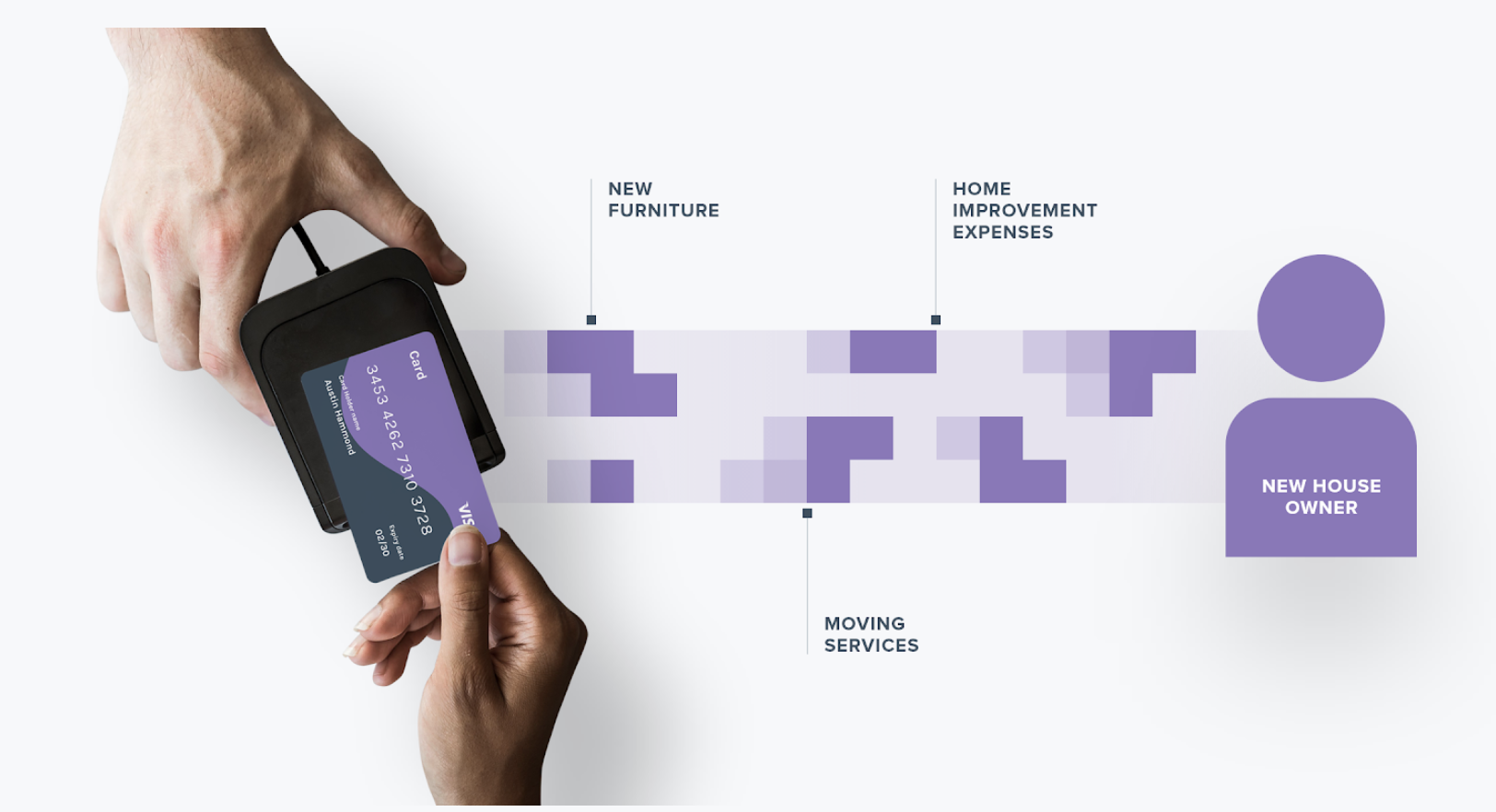
list companies in KSA and OutSide like Tink
- compare products with local fintech providers
- products in EU that can be done in here KSA
- Search directly on LinkedIn openBanking even part time