Kanban
tags :
Summary #
ref The Japanese word “kanban”, meaning “visual board” or “billboard” or a “sign”.* Kanban is an empirical method of optimizing any existing process.
Other key concepts in Kanban include: #
Definition of Workflow (DoW) #
The DoW defines key parts of the Kanban workflow, such as what units are moving through the board, what “started” or “finished” means, and how long it should take for an item to progress through the columns.
Work in progress (WIP) limits #
Teams can set WIP limits in a column, groups of columns, or the entire board. This means a column with a WIP limit of five can’t have more than five cards in it at a time. If there are five, the team must tackle the tasks in that column before new ones can be moved in. WIP limits can help surface bottlenecks in the production process.
Kaizen #
Meaning “improvement” in Japanese, kaizen encourages a mindset to continually better the process. This encourages all team members to share their insights and work to improve the team, not just managers.
Continuous improvement, flexible processes. #
Kanban helps visualize your work, limit work-in-progress (WIP) and quickly move work from “Doing” to “Done.”*
Kanban is great for teams that have lots of incoming requests that vary in priority and size. Whereas scrum processes require high control over what is in scope, kanban let’s you go with the flow. Let’s take a look at the same five considerations to help you decide.
Kanban cadence #
Kanban is based on a continuous workflow structure that keeps teams nimble and ready to adapt to changing priorities. Work items—represented by cards— are organized on a kanban board where they flow from one stage of the workflow(column) to the next. Common workflow stages are To Do, In Progress, In Review, Blocked, and Done. But that’s boring.
Release methodology #
In kanban, updates are released whenever they are ready, without a regular schedule or predetermined due dates.
In theory, kanban does not prescribe a fixed time to deliver a task. If the task gets completed earlier (or later), it can be released as needed without having to wait for a release milestone like sprint review.
Kanban roles #
The whole team owns the kanban board. Some teams enlist an agile coach but, unlike scrum, there is no single “kanban master” who keeps everything running smoothly. It’s the collective responsibility of the entire team to collaborate on and deliver the tasks on the board.
Key metrics #
Lead time and cycle time are important metrics for kanban teams. The deal with the average amount of time that it takes for a task to move from start to finish. Improving cycle times indicates the success of kanban teams.
The Cumulative Flow Diagram (CFD) is another analytical tool used by kanban teams to understand the number of work items in each state. CFDs help identify specific bottlenecks that need to be resolved for better throughput.
Another way to deal with bottlenecks is through Work In Progress (WIP) limits. A WIP limit caps the number of cards that can be in any one column at one time. When you reach your WIP limit, a tool like Jira Software caps that column, and the team swarms on those items to move them forward.
Change philosophy #
A kanban workflow can change at any time. New work items can get added to the backlog and existing cards can get blocked or removed based on prioritization. Also, if the team capacity changes, WIP limit can be recalibrated and work items adjusted accordingly. It’s all about being flexible in kanban.
Use Cases #
Managing Operations #
Scrum vs Kanban #
ref, ref 2 Kanban is a project management framework that relies on visual tasks to manage workflows, while scrum is a project management framework that helps teams structure and manage their work through a set of values, principles, and practices.
| Origin | Software Development | Learn Manufacturing |
|---|---|---|
| Idealogy | Learn through experiences, self-organize and prioritize, and reflect on wins and losses to continuously improve. | Use visuals to improve work-in-progress |
| Cadence | Regular, fixed-length sprints (i.e. two weeks) | Continuous flow |
| Practices | Sprint planning, sprint, daily scrum, sprint review, sprint retrospective | Visualize the flow of work, limit work-in-progress, manage flow, incorporate feedback loops |
| Roles | Product owner, scrum master, development team | No required roles |
Tool #
Trello can be used to implement kanban.
OCR of Images #
2023-09-03_17-51-51_screenshot.png #
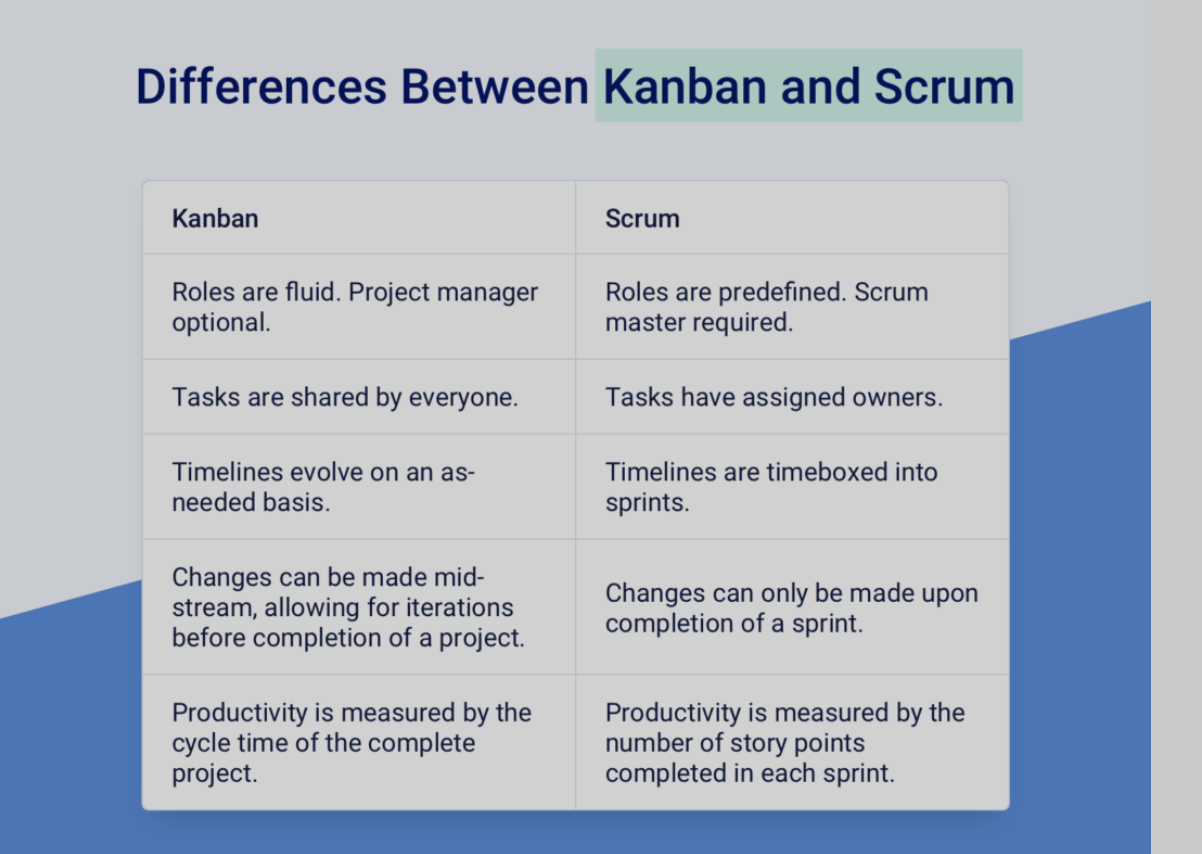
Differences Between Kanban and Scrum Kanban Scrum Roles are fluid. Project manager Roles are predefined. Scrum master required. optional. Tasks are shared by everyone. Tasks have assigned owners. Timelines evolve on an as- needed basis. Timelines are timeboxed into sprints. Changes can be made mid- stream, allowing for iterations before completion of a project. Changes can only be made upon completion of a sprint. Productivity is measured by the cycle time of the complete Productivity is measured by the number of story points completed in each sprint. project.
2023-09-03_18-31-59_screenshot.png #
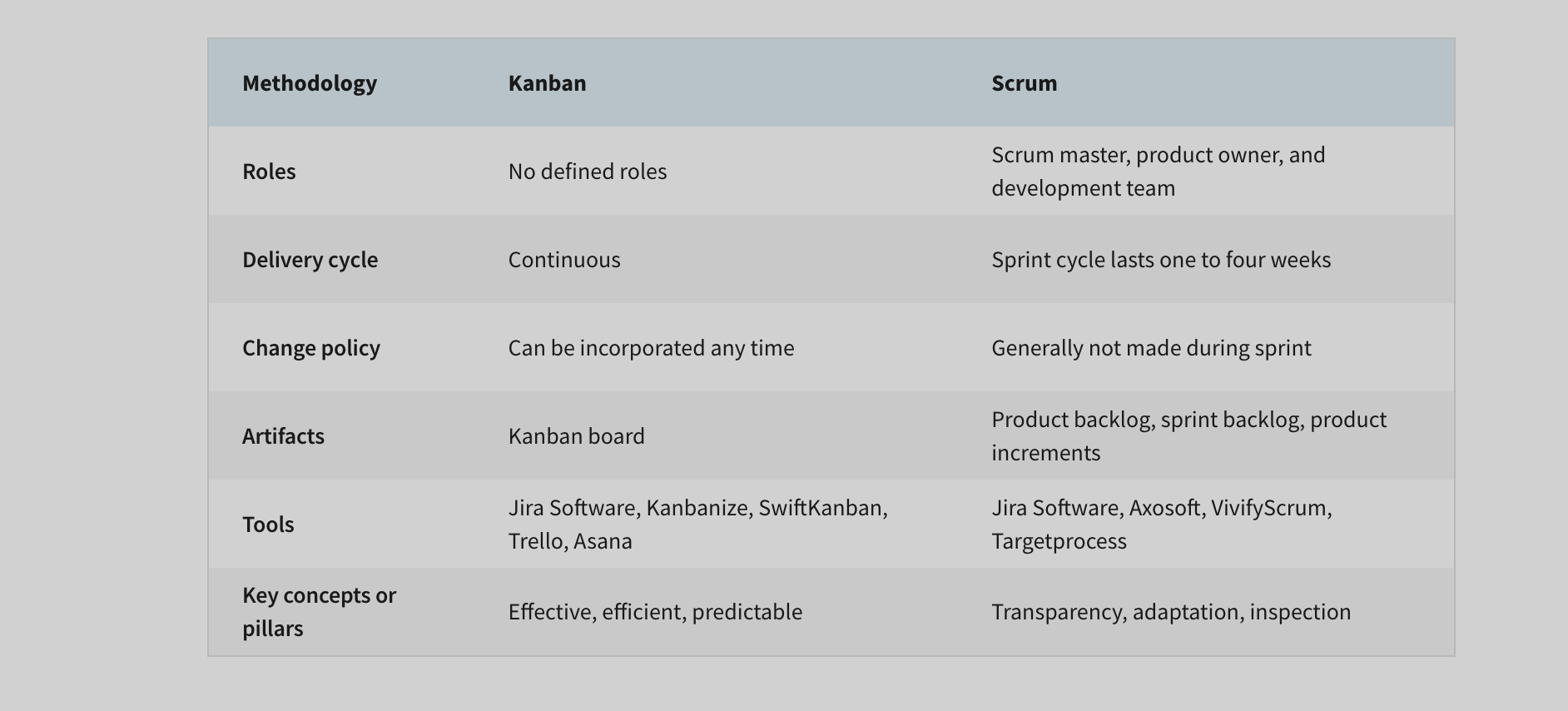
Methodology Kanban Scrum Scrum master, product owner, and development team Roles No defined roles Delivery cycle Continuous Sprint cycle lasts one to four weeks Change policy Can be incorporated any time Generally not made during sprint Product backlog, sprint backlog, product Artifacts Kanban board increments Jira Software, Kanbanize, SwiftKanban, Jira Software, Axosoft, VivifyScrum, Tools Trello, Asana Targetprocess Key concepts or pillars Effective, efficient, predictable Transparency, adaptation, inspection
OCR of Images #
2023-09-03_17-51-51_screenshot.png #
Differences Between Kanban and Scrum Kanban Scrum Roles are fluid. Project manager Roles are predefined. Scrum master required. optional. Tasks are shared by everyone. Tasks have assigned owners. Timelines evolve on an as- needed basis. Timelines are timeboxed into sprints. Changes can be made mid- stream, allowing for iterations before completion of a project. Changes can only be made upon completion of a sprint. Productivity is measured by the cycle time of the complete Productivity is measured by the number of story points completed in each sprint. project.
2023-09-03_18-31-59_screenshot.png #
Methodology Kanban Scrum Scrum master, product owner, and development team Roles No defined roles Delivery cycle Continuous Sprint cycle lasts one to four weeks Change policy Can be incorporated any time Generally not made during sprint Product backlog, sprint backlog, product Artifacts Kanban board increments Jira Software, Kanbanize, SwiftKanban, Jira Software, Axosoft, VivifyScrum, Tools Trello, Asana Targetprocess Key concepts or pillars Effective, efficient, predictable Transparency, adaptation, inspection
OCR of Images #
2023-09-03_17-51-51_screenshot.png #
Differences Between Kanban and Scrum Kanban Scrum Roles are fluid. Project manager Roles are predefined. Scrum master required. optional. Tasks are shared by everyone. Tasks have assigned owners. Timelines evolve on an as- needed basis. Timelines are timeboxed into sprints. Changes can be made mid- stream, allowing for iterations before completion of a project. Changes can only be made upon completion of a sprint. Productivity is measured by the cycle time of the complete Productivity is measured by the number of story points completed in each sprint. project.
2023-09-03_18-31-59_screenshot.png #
Methodology Kanban Scrum Scrum master, product owner, and development team Roles No defined roles Delivery cycle Continuous Sprint cycle lasts one to four weeks Change policy Can be incorporated any time Generally not made during sprint Product backlog, sprint backlog, product Artifacts Kanban board increments Jira Software, Kanbanize, SwiftKanban, Jira Software, Axosoft, VivifyScrum, Tools Trello, Asana Targetprocess Key concepts or pillars Effective, efficient, predictable Transparency, adaptation, inspection