EMV
- tags
- Fintech , Credit Card
Summary #
- EMV stands for “Europay, Mastercard, and Visa”, the three companies that created the standard.
- More secure than magnetic strip cards, not easy to steal data from the chip.
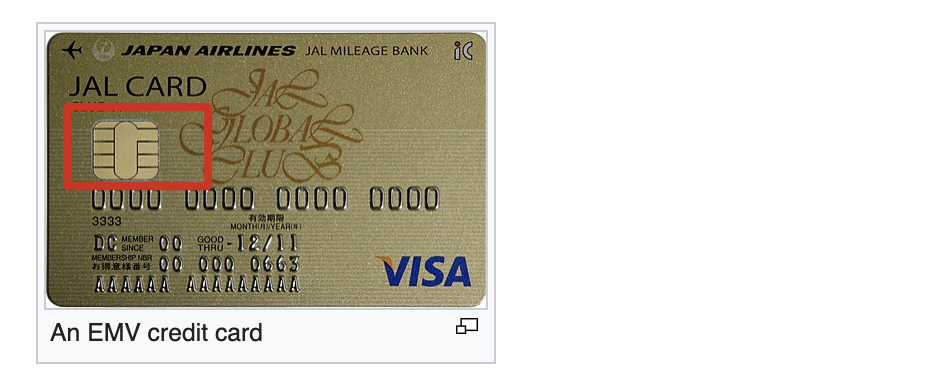
wikipedia #
EMV is a payment method based on a technical standard for smart payment cards and for payment terminals and automated teller machines(ATM) which can accept them.
- EMV cards are smart cards, also called chip cards, integrated circuit cards, or IC cards, which store their data on integrated circuit chips, in addition to magnetic stripes for backward compatibility.
- These include cards that must be physically inserted or “dipped” into a reader, as well as contactless cards that can be read over a short distance using near-field communication technology.
- Payment cards which comply with the EMV standard are often called chip and PIN or chip and signature cards, depending on the authentication methods employed by the card issuer, such as a personal identification number (PIN) or digital signature.
- Standards exist, based on ISO/IEC 7816, for contact cards, and based on ISO/IEC 14443 for contactless cards (Mastercard Contactless, Visa PayWave, American Express ExpressPay).[2]
How it works? #
- EMV chips transmit data just as magnetic strips on cards transmit data. However, payment terminals don’t read EMV chips the same way they read magnetic strips.
- A card with an EMV chip typically must be inserted into the slot of a payment terminal, which then reads the chip’s data and verifies the card as authentic. You then must wait for the purchase to be authorized. This process is known as “dipping.”
- By contrast, making a purchase by sliding a card with a magnetic strip through a card reader is called “swiping.”* The magnetic strip also transmits data that enables authorization of a purchase and verification of a card. A swiped transaction may be a bit quicker than a dipped transaction, but it’s not quite as secure.
Difference between dipping ( chip) and swiping (magnetic) #
One key difference between an EMV card and a magnetic strip card is that the EMV card produces a unique code for each transaction but the magnetic strip does not.
As such, it’s harder for fraudsters to steal data to produce counterfeit cards. That’s why merchants and card issuers prefer EMV transactions, even though they are more complicated than magnetic strip transactions.
Most cards in the U.S. depend on chip-and-signature capabilities. In this type of transaction, a cardholder must provide a signature to complete a transaction. Outside the U.S., chip-and-PIN transactions are more common. In these transactions, a cardholder enters a four-digit PIN to validate a payment. Chip-and-PIN transactions are considered more secure than chip-and-signature transactions.
Another way to use an EMV card is as a contactless payment method. If the card has this capability, you can tap it on a payment terminal or wave it near the terminal to complete the transaction. A contactless transaction doesn’t require a PIN.
OCR of Images #
2023-06-22_12-23-02_screenshot.png #
JAPAN AIRLINES JALMILEAGE BANK 8G JAL CARD /1 LA OB46 a - - 1 E D000 0000 0000 0000 3333 MONTHANYEARO) TROMER DGuun 00 9000-12/11 MEMBERSHPNBR BIEAAI 00 000 0663 AAAAAA AAAAAAAAA VISA An EMV credit card