ECC
- tags
- Security
Summary #
Elliptic Curve Cryptography (ECC) is a key-based technique for encrypting data. ECC focuses on pairs of public and private keys for decryption and encryption of web traffic.
ECC is frequently discussed in the context of the Rivest–Shamir–Adleman (RSA) cryptographic Algorithm. RSA achieves one-way encryption of things like emails, data, and software using prime factorization.
Details #
What is Elliptic Curve Cryptography? ECC, an alternative technique to RSA, is a powerful cryptography approach. It generates security between key pairs for public key encryption by using the mathematics of elliptic curves.
RSA does something similar with prime numbers instead of elliptic curves, but ECC has gradually been growing in popularity recently due to its smaller key size and ability to maintain security. This trend will probably continue as the demand on devices to remain secure increases due to the size of keys growing, drawing on scarce mobile resources. This is why it is so important to understand elliptic curve cryptography in context.
In contrast to RSA, ECC bases its approach to public key cryptographic systems on how elliptic curves are structured algebraically over finite fields. Therefore, ECC creates keys that are more difficult, mathematically, to crack. For this reason, ECC is considered to be the next generation implementation of public key cryptography and more secure than RSA.
It also makes sense to adopt ECC to maintain high levels of both performance and security. That’s because ECC is increasingly in wider use as websites strive for greater online security in customer data and greater mobile optimization, simultaneously. More sites using ECC to secure data means a greater need for this kind of quick guide to elliptic curve cryptography.
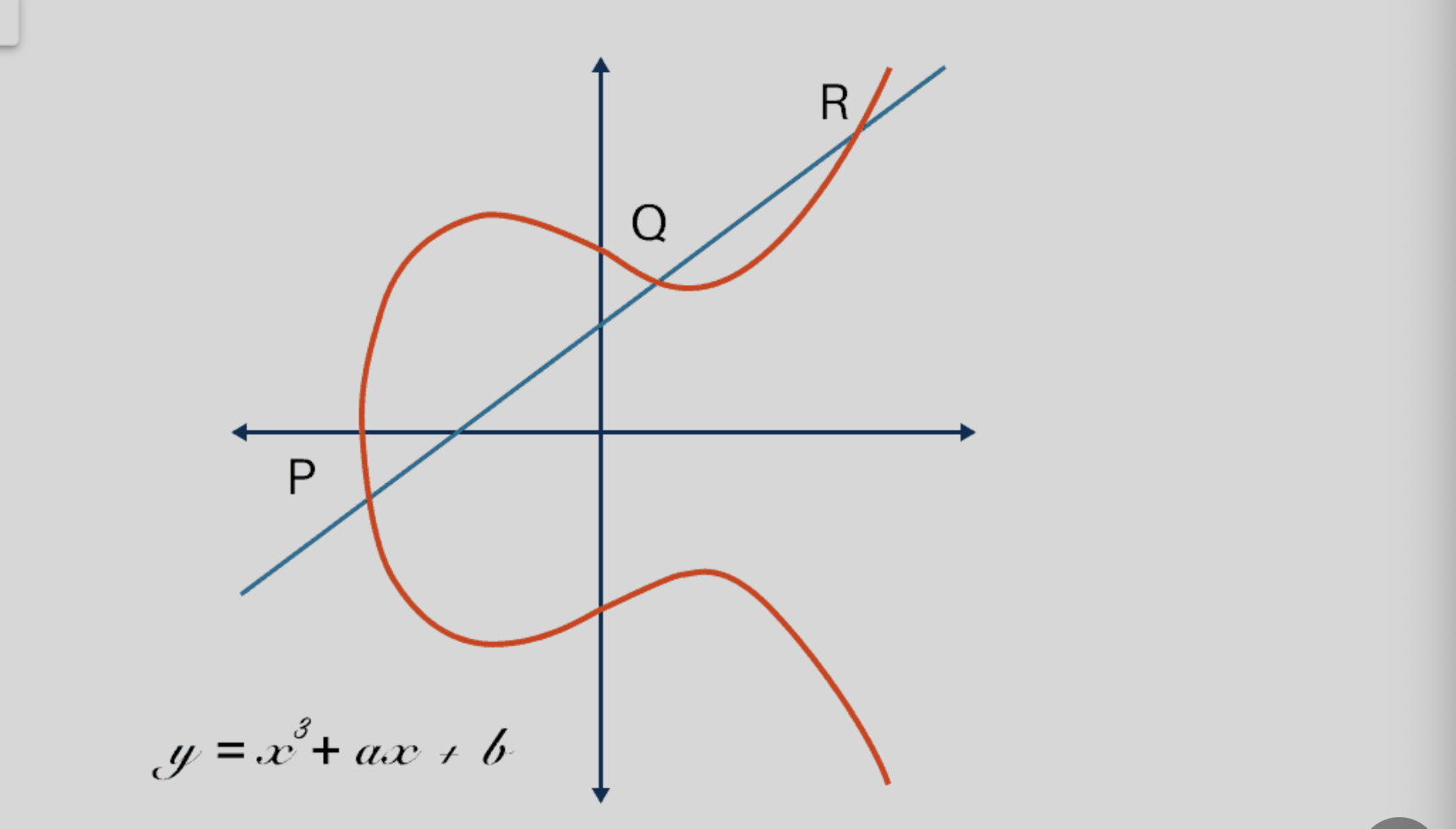
An elliptic curve for current ECC purposes is a plane curve over a finite field which is made up of the points satisfying the equation:
In this elliptic curve cryptography example, any point on the curve can be mirrored over the x-axis and the curve will stay the same. Any non-vertical line will intersect the curve in three places or fewer.
RSA vs ECC #
RSA Key Length (bit) 1024 2048 3072 7680 15360
ECC Key Length (bit) 160 224 256 384 521
Size is a serious advantage of elliptic curve cryptography, because it translates into more power for smaller, mobile devices. It’s far simpler and requires less energy to factor than it is to solve for an elliptic curve discrete logarithm, so for two keys of the same size, RSA’s factoring encryption is more vulnerable.
Using ECC, you can achieve the same security level using smaller keys. In a world where mobile devices must do more and more cryptography with less computational power, ECC offers high security with faster, shorter keys compared to RSA.
How it works? #
ref.
The way ECDSA works is an elliptic curve is that an elliptic curve is analyzed, and a point on the curve is selected. That point is multiplied by another number, thus creating a new point on the curve. The new point on the curve is very difficult to find, even with the original point at your disposal. The complexity of ECDSA means that ECDSA is more secure against current methods of encryption cracking encryptions. Along with being more secure against current attack methods, ECDSA also offers a variety of other benefits as well.
Example of Algorithms #
Secp256k1 #
- is the name of the elliptic curve used by Bitcoin to implement its public key cryptography. All points on this curve are valid Bitcoin public keys
- Can be used to generate ECDSA keys
OCR of Images #
2023-07-16_15-17-37_screenshot.png #
R P 3 + ail / 6